



Irish small businesses can use free artificial intelligence (AI) tools to draft emails, research business questions, summarise documents, analyse information and create marketing visuals without immediately committing to paid subscriptions. The right combination depends on the task, the free-plan limits and how the business handles sensitive information.
Ireland’s Central Statistics Office (CSO) reported that 20.2% of enterprises used AI in 2025, up from 8.1% in 2023. Adoption among small enterprises was 17.2%, compared with 57.7% among large enterprises. The figures show that AI adoption has grown, but smaller firms remain less likely than large enterprises to report using it.
For a sole trader or small team, the practical question is not how many AI applications are available. It is which free tools can solve genuine business problems without introducing unnecessary costs or data risks.
Key Facts
- Irish AI adoption: 20.2% of enterprises used AI in 2025, according to the CSO.
- Small-business adoption: 17.2% of small enterprises reported using AI.
- Everyday applications: Free AI assistants can help with drafting, research, summarisation and selected analysis tasks.
- Creative work: Canva offers a free plan with a limited allowance for certain AI features.
- Usage restrictions: Free plans can have separate limits for advanced models, file uploads, image creation or other features.
- Business data: Companies should assess confidentiality, privacy, access and human-review requirements before adopting an AI tool.
Table of Contents
- Why free AI tools matter to Irish small businesses
- The best free AI tools for everyday business tasks
- How to choose the right tool
- A practical free AI toolkit for Irish SMEs
- GDPR, privacy and responsible AI use
- When should a business pay for AI?
-
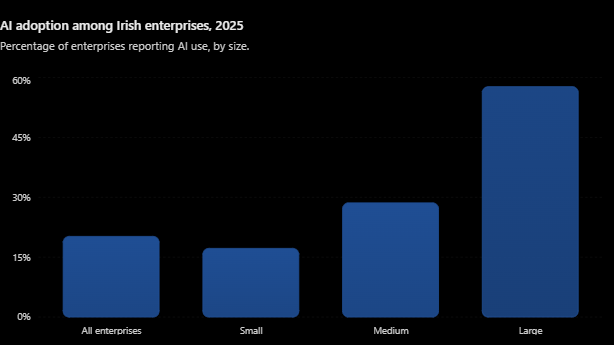
AI Adoption by Enterprise Size in Ireland, 2025
Why free AI tools matter to Irish small businesses
Small businesses often have to manage administration, customer communication, marketing and research with limited staff and budgets. AI tools can assist with selected tasks, but the benefits depend on how they are used and the quality of the information provided.
The CSO’s 2025 enterprise statistics show that business administrative processes were the most commonly reported purpose for AI use, at 7.8% of enterprises. Marketing or sales accounted for 5.4%, while accounting or financial management accounted for 4.7%.
These figures describe reported business use, not the proportion of firms that saved money or increased productivity. Nevertheless, they provide a useful starting point for deciding which everyday tasks are worth testing.
A business does not need to adopt several tools at once. Starting with one general-purpose assistant and one specialist tool can make it easier to measure usefulness, manage access and establish sensible rules.
The best free AI tools for everyday business tasks
The following shortlist focuses on practical use cases and products with free access. Features, availability and limits can change, so check each provider’s current plan details before relying on a particular capability.
1. ChatGPT — drafting, brainstorming and general assistance
ChatGPT’s free tier can assist with drafting emails, creating outlines, summarising supplied information, brainstorming campaign ideas and answering general questions. Depending on current availability and usage limits, it can also support web search, file analysis and image-related tasks.
Useful for:
- Drafting customer emails and internal communications.
- Producing first drafts of proposals and business documents.
- Brainstorming marketing campaigns.
- Summarising non-confidential material.
- Organising ideas into checklists and action plans.
Free-plan limitation: Some advanced models and tools have separate usage limits. Access to particular features can vary.
Practical example: A Dublin-based service business could ask ChatGPT to turn a list of services into a draft customer FAQ, then check every answer against its actual policies and prices.
Official reference: OpenAI’s ChatGPT Free Tier FAQ.
2. Google Gemini — research and document-related tasks
Gemini can help users brainstorm, draft text, explain concepts and work through research questions. Its available features depend on the account, plan, location and current usage limits.
Useful for:
- Generating initial research questions.
- Drafting and improving business communications.
- Explaining technical concepts in accessible language.
- Organising notes into structured summaries.
- Exploring ideas for customer-facing content.
Free-plan limitation: Google applies usage limits based on factors such as prompt complexity and the features being used. Some capabilities require a paid Google AI plan.
Practical example: A small retailer could use Gemini to brainstorm seasonal campaign ideas and prepare a draft content calendar, then verify dates, stock information and promotional terms.
Official reference: Google’s Gemini Apps limits and feature availability.
3. Canva — marketing visuals and social media content
Canva combines design tools with AI-assisted features. Its free plan is relevant to businesses that need simple promotional graphics, presentations and social media assets.
Useful for:
- Creating draft social media graphics.
- Preparing simple promotional materials.
- Designing presentations.
- Producing visual concepts for campaigns.
- Adapting content for different formats where the feature is available.
Free-plan limitation: Canva’s published plan information states that Free users have a limited monthly allowance for certain AI features. The allowance is shared across applicable tools, and more advanced features may be unavailable.
Practical example: A Cork-based café could create a draft seasonal promotion using its own photographs and verified menu information, then check the final design for accurate prices, dates and branding.
Official references: Canva pricing and Canva AI usage guidance.
4. Microsoft Copilot — an option to evaluate for Microsoft users
Businesses working with Microsoft software can evaluate Copilot for assistance with research, drafting and general productivity. However, the availability of free Copilot access should not be confused with the paid Copilot features integrated into business subscriptions.
Useful for:
- Drafting and improving business text.
- Exploring research questions.
- Summarising information supplied by the user.
- Generating ideas for presentations and communications.
Free-plan limitation: Features and integrations depend on the specific Copilot product and subscription. Do not assume that a free account includes paid Microsoft 365 business integrations.
Practical example: A small consultancy could test whether the available free experience helps create a first draft of a service description before deciding whether deeper integration is worth paying for.
Before publication, check Microsoft’s current official product and pricing information to confirm which free features are available to users in Ireland.
5. Perplexity — research and source discovery
Perplexity is another option to evaluate when a business needs to investigate a topic and locate sources. It can be useful at the early research stage, but generated summaries should not be treated as a substitute for checking original documents.
Useful for:
- Finding sources on a business question.
- Exploring market developments.
- Identifying relevant official publications.
- Building a preliminary research checklist.
- Locating material that needs further verification.
Free-plan limitation: Research modes, model access and usage allowances can differ by plan and may change. Verify the current free offering before publication.
Practical example: A small business considering a new service could use a research assistant to identify relevant government publications, then read the original documents before making a commercial decision.
How to choose the right free AI tool
The most useful tool is the one that supports a repeatable task while meeting the business’s requirements.
| Everyday task | Tool to test first | What to check |
|---|---|---|
| Email drafts | ChatGPT or Gemini | Accuracy, tone and editing time |
| Brainstorming | ChatGPT or Gemini | Relevance and originality |
| Research and source discovery | Perplexity or Gemini | Quality of original sources |
| Social graphics | Canva | Export requirements and AI allowance |
| General productivity | ChatGPT or Copilot | Available features and usage limits |
| Document summaries | ChatGPT or Gemini | File limits and confidentiality |
| Customer FAQs | ChatGPT or Gemini | Accuracy against approved business information |
This is a starting framework, not a universal performance ranking. The tools have different capabilities, and results depend on the task, account and workflow.
A practical free AI toolkit for Irish SMEs
A small business can start with a simple three-part approach.
Step 1: Choose one general assistant. Test ChatGPT or Gemini on a recurring, low-risk task such as drafting routine emails or organising ideas.
Step 2: Add a specialist tool only where needed. Canva may help with visual content, while a research assistant may help locate sources. Avoid creating multiple accounts without a clear purpose.
Step 3: Measure the result. Record how long the task took before and after using the tool. Check the output for errors and calculate whether the time saved is meaningful.
For example, a business could test the same type of routine email over a short trial period. It should compare preparation time, editing time and the number of factual corrections required. This produces evidence about that business’s own workflow instead of relying on general productivity claims.
GDPR, privacy and responsible AI use
Free access does not automatically mean that a tool is suitable for confidential business work.
Irish businesses should consider the General Data Protection Regulation (GDPR) and applicable data-protection requirements when using AI with personal information. They should also review the provider’s privacy terms, data controls, retention arrangements and permitted uses.
Practical safeguards include:
- Do not enter customer names, contact details, payment information or confidential records unless the tool and use case have been appropriately assessed.
- Remove identifying information from examples wherever possible.
- Check whether an AI service stores prompts, uses submitted data for model improvement or provides relevant privacy controls.
- Restrict employee access to approved tools and define acceptable use.
- Review AI-generated customer communications, financial information and business decisions before acting on them.
- Verify claims against primary sources, particularly for legal, tax, employment and regulatory questions.
An AI-generated answer is not proof of compliance. Businesses should consult appropriate professional advice where the consequences of an error are significant.
When should a business pay for AI?
A paid plan may be worth considering when a free tool repeatedly reaches its limits, when a business requires additional features, or when team management and contractual data protections are necessary.
Before upgrading, answer four questions:
- Which recurring task requires more capacity?
- How often does the free plan interrupt that task?
- What measurable benefit would the paid plan provide?
- Does the plan meet the organisation’s security, privacy and administrative requirements?
Do not pay simply because a provider markets a plan as business-ready. Compare the actual features, terms, costs and requirements of the intended use case.
What this means for Irish businesses
Free AI tools provide a low-cost way to test selected productivity workflows, but they are not interchangeable and do not remove the need for human judgement. The CSO’s adoption data provides a reason for Irish SMEs to investigate practical applications, not a guarantee that any particular tool will deliver savings.
A sensible starting point is one general-purpose assistant, one clearly defined task and a simple measurement of time, quality and risk. Businesses can then expand only when the evidence supports doing so.
For Irish small businesses, the strongest AI strategy is not to collect the largest number of tools. It is to identify the work that needs improving, choose an appropriate tool and use it responsibly.
takeaways
Key facts
| Fact | Verified evidence |
|---|---|
| Irish enterprise AI adoption | 20.2% in 2025 |
| Small enterprise adoption | 17.2% in 2025 |
| Large enterprise adoption | 57.7% in 2025 |
| Most common reported purpose | Business administrative processes, 7.8% |
| ChatGPT free access | Available with feature-specific limits |
| Gemini free access | Available with usage limits |
| Canva Free | Includes limited usage for certain AI features |
Sources: CSO, OpenAI, Google and Canva.
Key takeaways
-
Start with the task, not the tool.
-
Free access is different from unlimited access.
-
Check whether a capability belongs to the free plan or a paid subscription.
-
Use original sources to verify research and factual claims.
-
Protect personal and confidential business information.
-
Measure results before paying for a subscription.
Free AI tools can help small businesses draft emails, research topics, summarise documents and create marketing visuals without committing to paid subscriptions. ChatGPT and Gemini are options for general assistance, while Canva supports design work. Free-plan limits vary, so businesses should verify features and protect confidential data before use.
FAQs
1. What are the best free AI tools for small businesses?
ChatGPT and Gemini are useful starting points for general business assistance, while Canva is an option for visual content. The best choice depends on the task, available features and usage limits.
2. Are free AI tools genuinely free?
Some services offer ongoing free access, but advanced features may require payment. Distinguish a free plan from a time-limited trial, and review the current terms before signing up.
3. Is ChatGPT free for business use?
ChatGPT offers a free tier that can assist with everyday tasks. It has feature-specific usage limits, and businesses should review the applicable data-handling terms before using it for work.
4. Can small businesses use AI for marketing?
Yes. Businesses can use AI to brainstorm campaigns, draft content, organise ideas and create certain visual assets. People should review the output for accuracy, brand suitability and originality.
5. Can free AI tools analyse business documents?
Some free AI services support file uploads and analysis, subject to usage limits. Check the available functionality and do not upload confidential or personal information without assessing whether the service is appropriate.
6. Are free AI tools safe for confidential business data?
Not automatically. Safety depends on the provider, account settings, data terms and intended use. Businesses should avoid submitting sensitive information until the relevant privacy and security requirements have been assessed.
7. Can Irish businesses use AI tools under GDPR?
Potentially, provided the specific processing complies with applicable data-protection requirements. Businesses should consider their lawful basis, transparency, data minimisation, security and any obligations associated with their role in processing personal data.
8. Which free AI tool is best for social media graphics?
Canva is a practical option to test. Its free plan includes design capabilities and a limited allowance for certain AI features, so users should check current limits and export requirements.
9. Should a small business use several AI tools?
Not necessarily. Start with one general assistant and add a specialist tool only when it solves a distinct recurring problem. This makes costs, access and results easier to manage.
10. When should a business upgrade to a paid AI plan?
Consider upgrading when recurring work is constrained by free-tier limits or when additional features, team controls or contractual protections are required. Compare the expected benefit with the total cost before committing.
